Absence, and how a country handled it Haiku about war and loss
A haiku about loss cannot say anything about loss. That is the difficulty and also the reason the form survives contact with a subject that defeats most writing. It has room for one object: a photograph, a black bordered envelope, a stone with no name on it.
Eight poems Home front and after The old figure for the dead was 620,000. The 2011 estimate is closer to 750,000.
No army in this war issued identity tags. Men who expected to fight the next day wrote their names on scraps of paper and pinned them inside their coats, or bought private identification discs from a sutler, so that somebody might be able to say who they had been.
1. How many
For more than a century the standard figure was about 620,000 dead, assembled from muster rolls and pension records. In 2011 the demographic historian J. David Hacker published a new estimate in the journal Civil War History, built from census data rather than army paperwork, putting the toll at roughly 750,000, with a plausible range from about 650,000 to about 850,000.
| Question | The answer after the war | The answer now |
|---|---|---|
| How many died | About 620,000, from muster rolls and pension files | About 750,000 by the 2011 census based estimate, in a range of 650,000 to 850,000 |
| Of what | Combat assumed to dominate | Roughly two deaths from disease for every one in battle |
| Who they were | No identity tag was ever issued by either army | Close to half the Union dead reinterred after the war could not be named |
| Where they lie | Battlefield burials, most of them temporary | About 300,000 Union dead reinterred in national cemeteries between 1866 and 1871 |
Wide table: scroll sideways to read it all.
before the advance
Written for this collection. Ground: no identity tag was issued; soldiers improvised their own before an action.
he pins his name
inside his coat
2. Not knowing
The worst outcome for a family was not a death. It was silence: a man listed as missing, a regiment that had moved, a letter that stopped. Newspapers printed casualty lists that were wrong. Families travelled to battlefields to look for a body themselves.
One case became famous because it was solved. A Union sergeant killed at Gettysburg on 01/07/1863 was found with no identification at all, holding an ambrotype of three small children. The photograph was reproduced and circulated in the press, and in November 1863 a woman in Portville, New York recognised her own children. The man was Amos Humiston of the 154th New York. Money raised through the story helped establish an orphanage at Gettysburg after the war.
a photograph found
Written for this collection. Ground: the ambrotype found on a Union sergeant at Gettysburg, 01/07/1863, and circulated until it was recognised.
three children looking
at whoever finds it
It is a famous story precisely because it is exceptional. The ordinary version of it has no ending at all.
3. The condolence letter
Nineteenth century Americans had firm expectations about how a person should die: at home, conscious, composed, with family present and last words spoken. A war fought hundreds of miles away destroyed every one of those conditions, so soldiers reconstructed them by post.
Comrades and nurses wrote to families describing a man's last hours in a settled formula: he was conscious, he did not suffer long, he spoke of home, he was buried decently and the grave was marked. Drew Gilpin Faust's This Republic of Suffering, published in 2008, is the standard account of this and of everything that follows from it.
the letter says
Written for this collection. Ground: the standard condolence letter written by comrades and nurses, following a settled formula.
he did not suffer
in a stranger's hand
4. Mourning at home
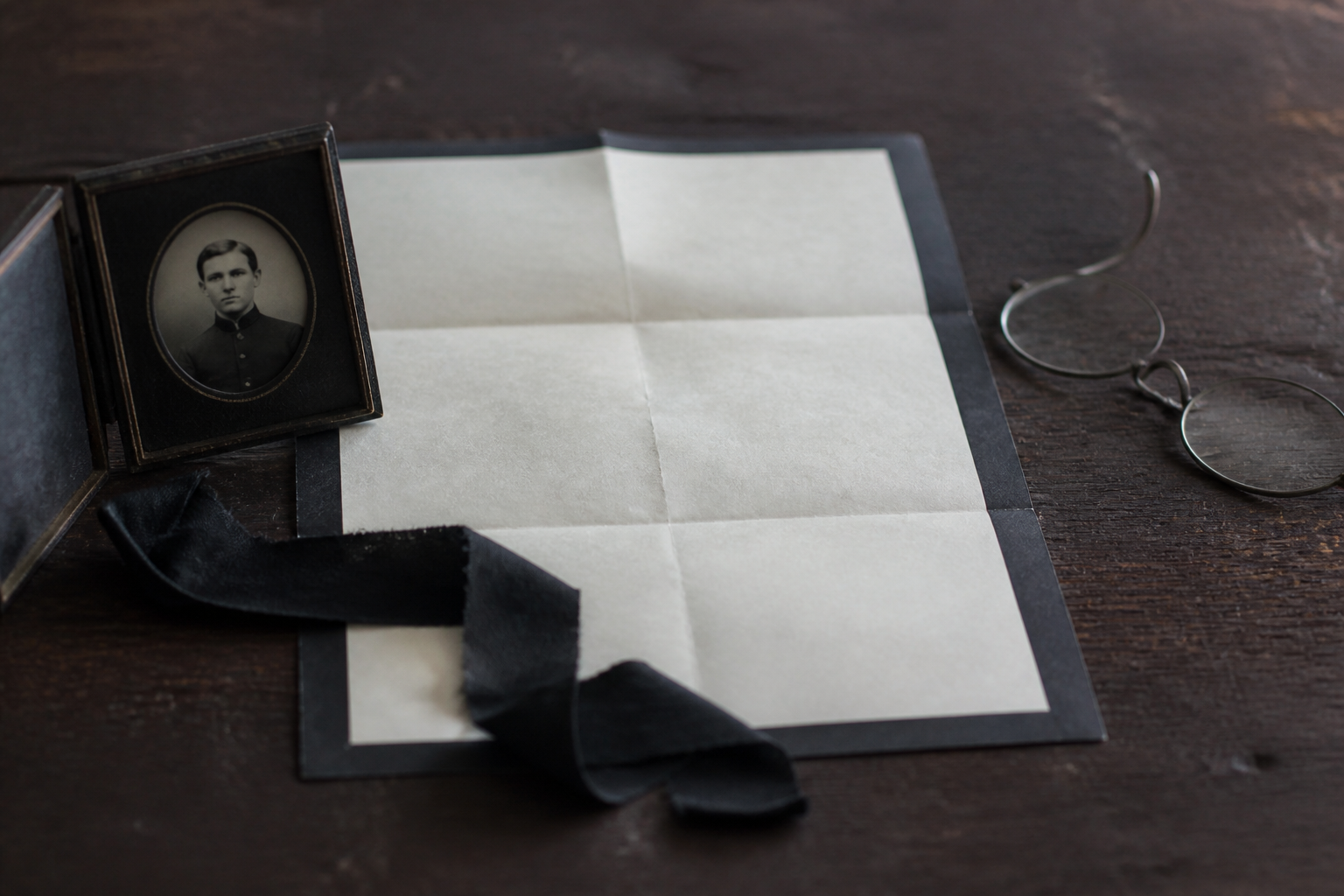
Mourning was public, coded and expensive. Black crape on the door and on the sleeve. Mourning dress worn for a period fixed by custom rather than by feeling. Stationery with a black border, the width of the border narrowing as the months passed. Jewellery woven from a dead man's hair. Photographs turned to the wall or, more often, kept exactly where they were.
black-edged paper
Written for this collection. Ground: mourning stationery carried a black border that was narrowed as the mourning period advanced.
the border narrower
than it was in spring
her mourning dress
Written for this collection. Ground: mourning dress was worn for a period set by custom, through whatever else happened.
taken in twice
in one year
5. Bringing them back
Embalming became a commercial trade during this war, advertised near the armies and priced by rank. Families who could pay had bodies shipped home by rail in sealed metal coffins. Families who could not pay had a grave they would never see.
After the war the federal government undertook a reburial programme, searching battlefields and hospital grounds and reinterring roughly 300,000 Union dead in national cemeteries between 1866 and 1871. Something close to half of them could not be identified. Confederate reburial was organised privately, largely by women's memorial associations.
half the stones
Written for this collection. Ground: close to half the Union dead reinterred between 1866 and 1871 could not be identified.
say unknown
and are the same size
6. Decoration Day
On 05/05/1868 General John A. Logan, head of the Union veterans' organisation, issued an order designating 30/05/1868 for strewing flowers on the graves of the war dead. Local observances had already been happening for several years in several places, north and south, and more than one town has a reasonable claim to being first. The federal holiday now called Memorial Day grew out of these.
thirtieth of May
Written for this collection. Ground: the first nationally ordered Decoration Day, 30/05/1868.
flowers on a name
and on no name
7. What the poets said
Walt Whitman spent much of the war visiting hospitals in Washington. He published Drum-Taps in 1865 and returned to the subject in Specimen Days in 1882, where he wrote the sentence that hangs over every attempt at this material: the real war, he said, will never get in the books.
Herman Melville published Battle-Pieces and Aspects of the War in 1866. Emily Dickinson wrote through the war years without addressing the war directly, and 1862, the year of Antietam and Fredericksburg, was the most productive year of her life.
what the books hold:
Written for this collection. Ground: written against Whitman's remark in Specimen Days, 1882, that the real war will never get in the books.
one field, one hour
one man's coat
A working position
- Whitman was right: no book contains the war.
- A short poem does not pretend to. It contains one object.
- That is a smaller claim, and it is the only honest one available.