01 to 03/07/1863 · Adams County, Pennsylvania Haiku poems about Gettysburg
Gettysburg is the hardest ground in this collection to write short poems about, because it has been written about more than any other place in the country and almost every image has been used. The way through is the calendar. The three days do not look alike, they do not smell alike, and they do not happen on the same kind of ground.
Eight poems Three days About 51,000 casualties on both sides across the three days.
Gettysburg was a market town of roughly 2,400 people where ten roads met. The armies did not choose it. They collided at it, and the road junction decided the rest.
1. Before the armies
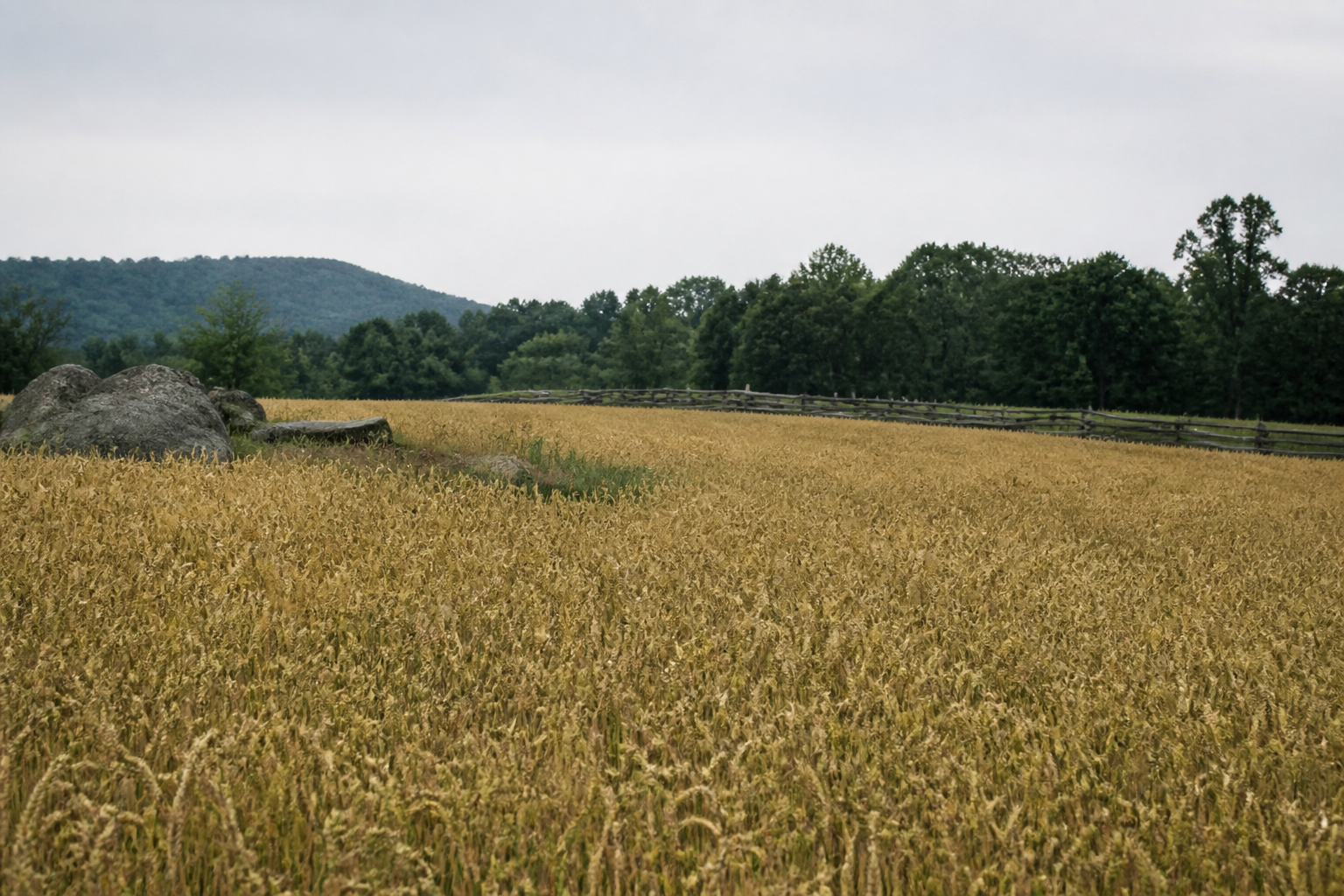
In the last days of June 1863 the wheat around Gettysburg was standing and close to ripe, the orchards were in fruit, and the ten roads that met in the town square carried farm traffic. That is the picture a poem has to start from, because the reader needs to feel the ordinary before anything happens to it.
ten roads, one square
Written for this collection. Ground: Gettysburg was a road junction town of roughly 2,400 people; the wheat was close to ripe.
wheat standing to the fence
the last week of June
The Lutheran Theological Seminary stood on a ridge west of town, and its cupola gave the best view in the district. It was used for exactly that on the first morning.
seminary cupola
Written for this collection. Ground: the seminary cupola west of town gave the best observation point in the district, and was used as one on 01/07/1863.
two men taking turns
at one field glass
2. First day, 01/07/1863
The fighting began west and north of the town and moved through it. By late afternoon Union troops had been pushed back through the streets to the high ground south of the cemetery, which is the ground they held for the next two days. The town itself changed hands, and civilians spent the rest of the battle in their cellars.
One resident, Mary Virginia Wade, known as Jennie, was killed on 03/07/1863 by a bullet that came through two doors of her sister's house while she was making bread. She was the only civilian killed during the battle, which is worth stating plainly whenever a poem is tempted to make the town into a symbol.
3. Second day, 02/07/1863
The second day is the day of place names: Devil's Den, the Wheatfield, the Peach Orchard, Little Round Top, Culp's Hill. It is also the day of ground that a poem can actually use, because all of those places are different textures. Boulders, standing wheat, fruit trees, piled stone.
second day, boulders
Written for this collection. Ground: Devil's Den, a field of large boulders on the southern end of the field.
a sharpshooter's nest
the size of a grave
wheat ripe and standing
Written for this collection. Ground: the Wheatfield, John Rose's crop, changed hands repeatedly on 02/07/1863.
by evening the field
harvested twice
on Little Round Top
Written for this collection. Ground: troops built stone breastworks by hand on the rocky southern hills.
stones piled by hand
into a low wall
The Wheatfield changed hands repeatedly through the afternoon. Plum Run, the small stream below it, was called Bloody Run afterwards. The wheat itself belonged to a farmer named John Rose, and it was a crop before it was a battlefield.
4. Third day, 03/07/1863
The third day opens with an artillery bombardment of roughly one hundred and fifty Confederate guns, answered by Union batteries on the ridge, and then stops. The silence after it is reported in almost every account written by anyone who was there. Then about twelve to thirteen thousand men walked across three quarters of a mile of open farmland toward a low stone wall.
third day, one o'clock
Written for this collection. Ground: the Confederate bombardment of 03/07/1863 involved roughly one hundred and fifty guns; the silence after it is described in account after account.
a hundred and fifty guns
then the quiet
three quarters of a mile
Written for this collection. Ground: the distance crossed in the assault of 03/07/1863, toward the wall at the Angle.
of open farmland
and a low stone wall
The assault is usually called Pickett's Charge, after one of the three division commanders involved. It failed in under an hour. If you write about it, the two things worth keeping are the silence and the distance, because both are measurable and neither needs adjectives.
5. The rain, 04/07/1863
Heavy rain fell on 04/07/1863 as Lee began withdrawing south. The wounded were still on the field. The wagon train of the wounded stretched for miles on roads turning to mud. In terms of what a short poem can hold, this is the most useful weather in the battle, because rain falls on everyone equally and asks the poet to say nothing at all.
the fourth of July
Written for this collection. Ground: heavy rain fell on 04/07/1863, with thousands of wounded still lying out.
rain finding every man
still in the field
6. The three days, side by side
| Day | Date | Where the fighting was | Images the ground offers |
|---|---|---|---|
| First | 01/07/1863 | West and north of town, then the streets | Dust, a seminary cupola, ripe wheat, ten roads, cellars |
| Second | 02/07/1863 | Devil's Den, the Wheatfield, the Peach Orchard, Little Round Top, Culp's Hill | Boulders, fruit trees, stone breastworks, a small creek |
| Third | 03/07/1863 | Cemetery Ridge and the low wall known as the Angle | Massed guns, then silence, open ground, a copse of trees |
| After | 04/07/1863 | The roads south | Heavy rain, wagons, mud, the field still occupied by the wounded |
Wide table: scroll sideways to read it all.
7. Brevity, 19/11/1863
Four and a half months later the Soldiers' National Cemetery was dedicated on the ground south of town. Edward Everett, the principal speaker and one of the most admired orators in the country, spoke for about two hours. Abraham Lincoln then spoke for about two minutes, in roughly two hundred and seventy words.
That contrast is the reason a page about short poems can put Gettysburg at its centre without apology. The most quoted piece of American prose about this battle is shorter than the average blog paragraph, it is built almost entirely of plain words, and it does not describe the fighting at all.
Worth noticing
- Everett wrote to Lincoln the next day saying he wished he had come as near the heart of the occasion in two hours as Lincoln had in two minutes.
- Five manuscript copies in Lincoln's hand survive, and they differ slightly from one another.
- The word length quoted for the address depends on which copy is counted.
8. What to avoid
Four moves have been made so often on this ground that they now read as noise rather than as writing.
- Blood in the wheat. Used past exhaustion, and it tells a reader nothing they did not already assume.
- Ghosts. The battlefield does not need a supernatural layer. It has an inventory.
- The high water mark. A retrospective judgement, not something anyone could see on 03/07/1863.
- Quoting the address inside the poem. Lincoln's words are better than the poem will be, and they will simply take it over.
The alternative is not cleverness. It is inventory: what was growing, what the weather was, what the ground was made of, what time it was. the same advice, for a classroom