Camp, march, ration, mail Civil war soldier life poems
A soldier in this war spent a few days under fire and a few hundred days waiting. The waiting is where almost all the writing worth reading comes from, and it is also where a short poem has the best chance, because nothing in it needs to be raised to the level of an event.
Eight poems The ordinary day Disease killed roughly two soldiers for every one killed in action.
Roughly 2.1 million men served in the Union armies. Estimates for Confederate service run from about 750,000 to about a million. Around 180,000 Black soldiers served in the United States Colored Troops, with roughly another 19,000 in the Navy.
1. Mostly waiting
Read a soldier's diary from any year of this war and the ratio is immediately obvious. Pages of weather, rations, drill, mud, mail and rumour; then two lines about a battle; then pages of weather again. Memoirs written after the war reversed that ratio, which is one reason memoirs are less useful to a poet than diaries.
four months of weather
Written for this collection. Ground: the ordinary proportions of a soldier's diary, as against a memoir written afterwards.
in the diary
two lines for the battle
The single best English language account of the ordinary side of it is John D. Billings's Hardtack and Coffee, published in 1887 by a man who had served in a Massachusetts artillery battery. It describes the ration, the tent, the louse and the pay day, and it is still in print. the rest of the reading list
2. The ration
The regulation ration looked adequate on paper and rarely arrived intact. What survived the journey was hard bread, salt pork and coffee, which is why those three things appear in nearly every letter written from a camp.
| Item | What the regulations allowed | What it meant in practice |
|---|---|---|
| Hard bread | About a pound a day when soft bread was not available | Squares of flour and water roughly three inches across, often infested, usually soaked in coffee before they could be eaten |
| Meat | About twelve ounces of salt pork or bacon, or a larger weight of beef | Salt pork most of the time; fresh beef only when a herd was moving with the column |
| Coffee | Issued green, with sugar, by the hundred rations | Roasted in a pan and crushed with a rifle butt or a stone. The most valued thing a soldier owned |
| Vegetables | Beans or rice, plus pressed dried vegetables | The dried vegetable cakes were universally detested and universally issued |
| Extras | Vinegar, salt, sometimes molasses | Traded, gambled for, or bought at high prices from the sutler who followed the army |
Wide table: scroll sideways to read it all.
ration day
Written for this collection. Ground: hard bread was issued for several days at a time and had to be soaked before eating.
three days of hard bread
one of them stone
3. Camp and winter quarters
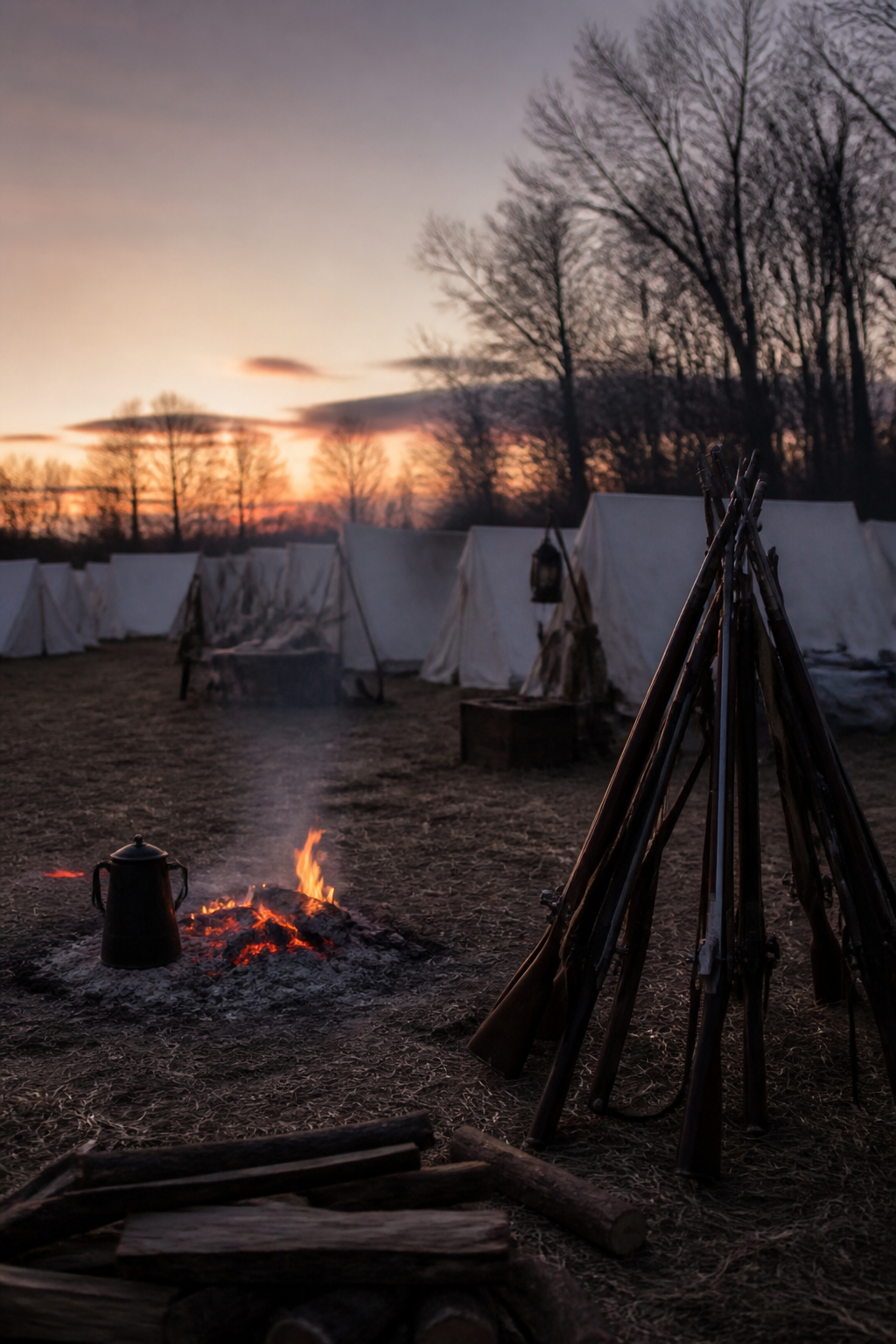
In the field two men shared a shelter tent, each carrying half of it, which is why an army on the march was full of men looking for their tent partner. In winter the armies stopped and built: log huts roofed with tent canvas, chimneys of mud and sticks or of stacked barrels, streets laid out by company, newspapers pasted to the inside walls against the draught.
shelter half, one man
Written for this collection. Ground: each soldier carried half a shelter tent; two men had to pair up to have any tent at all.
waiting in the rain
for the other half
January hut
Written for this collection. Ground: winter quarters were log huts with mud chimneys, papered inside against the draught.
newspaper on the wall
four months out of date
4. Disease
The great killer of this war was not the rifle. It was typhoid, dysentery, measles, pneumonia and what the returns called chronic diarrhoea. Roughly two soldiers died of disease for every one killed in action, and regiments raised in the countryside were hit hardest, because farm boys arrived without the childhood immunities that town boys had.
fever in the ranks
Written for this collection. Ground: typhoid, dysentery and measles emptied regiments faster than battle did.
the drum still sounding
for fewer men
This is the fact that most reshapes a collection of war poems. If you write only about battles you have written about the minority of the deaths. how the country counted them
5. Mail and music
Mail was the centre of camp life. Men who could not write dictated; men who could wrote for others. Letters were read aloud, kept, reread and carried until they fell apart. The surviving correspondence of this war runs to millions of items and is the reason we know what we know about it.
mail call
Written for this collection. Ground: mail was the central event of camp life, and letters were routinely read aloud and shared.
the man with no letter
holds the sack
Music did the other half of the work. Julia Ward Howe's Battle Hymn of the Republic appeared in The Atlantic Monthly in February 1862. Walter Kittredge wrote Tenting on the Old Camp Ground in 1863. Lorena and Home, Sweet Home were sung on both sides, and both were thought dangerous to morale for the plain reason that they worked.
someone starts Lorena
Written for this collection. Ground: Lorena and Home, Sweet Home were sung on both sides and were thought bad for morale.
the whole camp
going quiet the same way
6. Pay, and who got paid what
A Union private was paid thirteen dollars a month, raised to sixteen dollars in 1864. Black soldiers were at first paid ten dollars a month with three dollars deducted for clothing, leaving seven. Congress equalised the pay in June 1864 and made it retroactive.
The 54th Massachusetts Infantry refused to accept any pay at all for over a year rather than take the lower rate. That is not an anecdote about morale. It is a documented eighteen month argument conducted by men who were also being shot at, and it belongs in any honest account of what soldier life was.
pay table in the mud
Written for this collection. Ground: unequal pay for Black soldiers ended with the act of Congress of June 1864, made retroactive.
one line of men
waiting for the same wage
7. Writing the ordinary
Poems about camp life go wrong in one direction only: they make the ordinary meaningful. It already is. A short poem about a ration does not need to hint at mortality; the reader knows perfectly well where the man eating it is going.
- Name the object exactly. Hard bread, not food. Shelter half, not tent.
- Keep the hour. Coffee before light is a different poem from coffee at noon.
- Let the boredom be boring. A flat poem about waiting is closer to the truth than an anxious one.
- Most camp poems are really senryu, and they improve when you admit it. the difference between haiku and senryu