11 to 15/12/1862 · Fredericksburg, Virginia A Fredericksburg battle poem
Fredericksburg is a battle with one shape and no ambiguity: a river crossed late, a town fought through, an open slope, a sunken road, a stone wall. Nothing about it is subtle, which is precisely why it needs the quietest poems in this collection.
Seven poems Winter Union casualties about 12,600; Confederate casualties about 5,300.
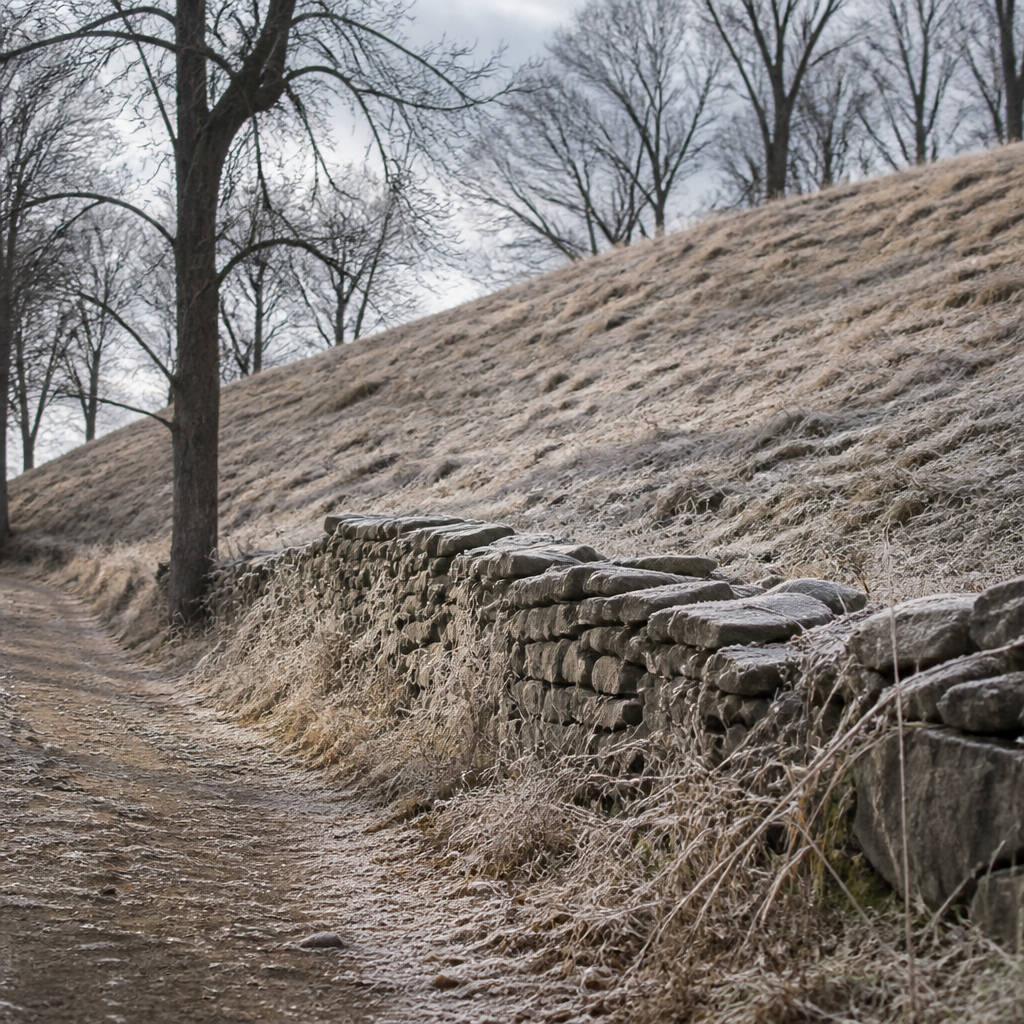
The wall at the foot of Marye's Heights was about four feet high, with a farm lane sunk behind it. Infantry standing in that lane were almost invisible from the field, and the field in front of them had no cover of any kind.
1. The river and the delay
The Union plan required pontoon bridges to cross the Rappahannock. The army arrived at the river in the middle of November 1862; the pontoons did not. By the time the bridging train came up, Lee's army had occupied the heights on the far bank at leisure. The battle was lost in a supply schedule before a shot was fired.
December river
Written for this collection. Ground: the bridging train reached the Rappahannock long after the army did, which handed Lee the heights.
the pontoons arriving
three weeks after the plan
On 11/12/1862 engineers tried to lay the bridges under rifle fire from riflemen in the town. Union infantry eventually crossed the river in the pontoon boats themselves and cleared the streets house by house, which was among the war's first serious experiences of urban fighting.
boats across at dawn
Written for this collection. Ground: engineers laid the bridges under rifle fire on 11/12/1862; infantry crossed in the pontoon boats to clear the town.
the engineers working bent
like men against rain
2. The town, 11 to 12/12/1862
Once across, Union soldiers looted the town. Accounts from both armies describe furniture, books, mirrors and pianos dragged into the streets and left in the mud. Officers wrote about it with embarrassment at the time; it is not a detail supplied later by anyone's enemies.
a parlour in the street
Written for this collection. Ground: the looting of Fredericksburg on 11 and 12/12/1862, described with embarrassment by Union officers at the time.
the piano out in the mud
still in tune
For a poet this matters because it is the one part of the battle that is neither heroic nor tragic. It is just people behaving badly in a cold street, and a short poem can hold that without any commentary at all. why the form refuses to comment
3. The wall, 13/12/1862
On 13/12/1862 the Union army made repeated brigade sized assaults across open ground toward Marye's Heights. The usual count is fourteen. None of them reached the stone wall. Union losses on that slope made up the great majority of the roughly 12,600 casualties the army suffered in the battle.
half a mile of grass
Written for this collection. Ground: the open slope below Marye's Heights, and the sunken lane behind the wall.
then the stone wall
then the quiet men
fourteen times uphill
Written for this collection. Ground: the usual count of Union brigade assaults on 13/12/1862. None reached the wall.
the same field
a little more crowded
| Item | Union | Confederate |
|---|---|---|
| Commander | Ambrose E. Burnside | Robert E. Lee |
| Strength, approximate | About 114,000 | About 72,500 |
| Casualties, approximate | About 12,600 | About 5,300 |
| Ground held at the end | The town, then abandoned | The heights, throughout |
| Assaults that reached the wall | None | Not applicable |
Wide table: scroll sideways to read it all.
4. The night of the aurora, 14/12/1862
On the night of 14/12/1862 an unusually strong aurora borealis was visible over northern Virginia. Soldiers in both armies recorded it. Auroras are rare at that latitude, and men who had never seen one described the whole northern sky as red.
The wounded were still lying on the slope. The temperature dropped hard, and accounts describe men crawling behind the bodies of the dead for shelter from the wind and from fire. The aurora is the only image in the whole battle that both armies looked at in the same way at the same moment.
northern lights
Written for this collection. Ground: the aurora borealis reported over the battlefield on the night of 14/12/1862, with the wounded still on the slope.
over a Virginia field
and nobody moving
5. The water carrier
The best known story of the battle is that of Richard Rowland Kirkland, a sergeant of the 2nd South Carolina, who is remembered as the Angel of Marye's Heights for going over the wall with canteens to give water to wounded Union soldiers. He was killed at Chickamauga in September 1863.
It is worth being exact about the evidence. The story rests principally on an account published in 1880 by Joseph B. Kershaw, who had commanded Kirkland's brigade, in a Charleston newspaper. That is eighteen years after the event, from a single source, and historians have debated the details ever since. Kirkland was certainly real, and certainly killed in 1863. What he did on that slope is remembered rather than documented.
a canteen carried
Written for this collection. Ground: the story of a Confederate sergeant taking water to wounded Union soldiers. Remembered from an 1880 account, not documented at the time.
across the same forty yards
that killed all day
How this collection handles a story like that
- The poem uses the action, because a canteen carried across open ground is an image.
- The note says the story is remembered rather than proved, because a reader deserves to know.
- No name is put in the poem, because attaching a real man's name to an invented line is where writing about history goes wrong.
6. Why so few words
A paragraph about Fredericksburg has to explain: the pontoons, the delay, the crossing, the looting, the ground, the wall, the count of assaults, the cold. A poem cannot do any of that and should not try. What a poem can do is put one measurable thing in front of a reader and let the paragraph they have already read do the rest.
That is why the notes under the poems on this site matter as much as the poems. The prose carries the facts. The poem carries the forty yards.